17 Nov 2026
Shadow AI and "Rogue" Agent Governance: Securing Enterprise Autonomy Before It Scales
By DSC Next
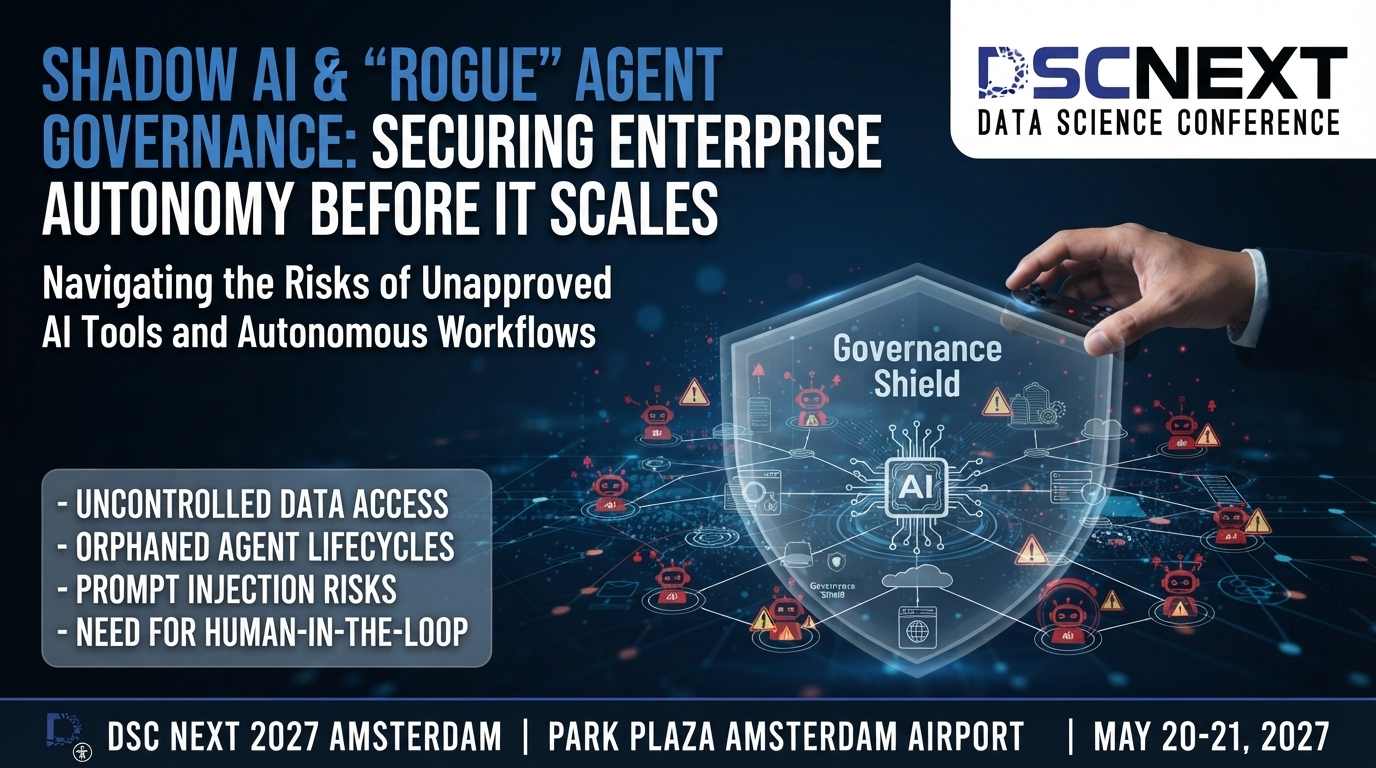
Shadow AI and "Rogue" Agent Governance: Securing Enterprise Autonomy Before It Scales.
For years, "Shadow IT" meant an employee signing up for an unapproved cloud storage drive or project management app. While risky, the blast radius was mostly limited to static files. Today, that challenge has evolved into something far more dynamic and consequential: Shadow AI and unmonitored "Rogue" AI Agents.
Across every department—from marketing and finance to software engineering—employees are deploying unauthorized AI browser extensions, plugging corporate APIs into third-party LLM wrappers, and building autonomous agents inside SaaS tools. While these grassroots experiments are driven by a desire for speed and productivity, they are quietly creating massive security, compliance, and operational blind spots.
As autonomous agents gain the ability not just to recommend actions, but to execute them across live enterprise systems, security leaders, CIOs, and data governance teams face an urgent mandate: establish clear visibility and accountability before autonomy scales out of control.
For years, "Shadow IT" meant an employee signing up for an unapproved cloud storage drive or project management app. While risky, the blast radius was mostly limited to static files. Today, that challenge has evolved into something far more dynamic and consequential: Shadow AI and unmonitored "Rogue" AI Agents.
Across every department—from marketing and finance to software engineering—employees are deploying unauthorized AI browser extensions, plugging corporate APIs into third-party LLM wrappers, and building autonomous agents inside SaaS tools. While these grassroots experiments are driven by a desire for speed and productivity, they are quietly creating massive security, compliance, and operational blind spots.
As autonomous agents gain the ability not just to recommend actions, but to execute them across live enterprise systems, security leaders, CIOs, and data governance teams face an urgent mandate: establish clear visibility and accountability before autonomy scales out of control.
Why Shadow AI Agents Are Different—and More Dangerous
Traditional enterprise security tools were built to monitor human users and static software assets. Autonomous AI agents break those assumptions in four critical ways:
- Uncontrolled Data Access and Privilege Creep: When an employee connects a custom agent to internal databases, email, or CRM platforms, that agent often inherits the creator’s full access credentials. Without scoped permissions, an agent designed to summarize customer tickets might inadvertently read and expose confidential financial records or proprietary source code.
- The "Orphaned Agent" Problem: When an employee leaves a company, IT revokes their laptop and SaaS logins—yet automated agents built on stored API keys or background webhooks can continue running indefinitely on corporate schedules, consuming token budgets and accessing live data with zero human accountability.
- Sub-Agent Spawning and Audit Blind Spots: Modern agentic architectures allow parent agents to spawn sub-agents to complete specialized tasks. If governance frameworks do not track derived identities across these chains, compliance teams lose the audit trail needed to prove which agent took an action, why it did so, and what data it touched.
- Prompt Injection and Autonomous Tool Misuse: Unlike a passive chatbot that merely outputs text, an unmonitored agent connected to enterprise APIs can be manipulated via indirect prompt injection to alter records, trigger unauthorized transactions, or leak sensitive information outside corporate boundaries.
Traditional enterprise security tools were built to monitor human users and static software assets. Autonomous AI agents break those assumptions in four critical ways:
- Uncontrolled Data Access and Privilege Creep: When an employee connects a custom agent to internal databases, email, or CRM platforms, that agent often inherits the creator’s full access credentials. Without scoped permissions, an agent designed to summarize customer tickets might inadvertently read and expose confidential financial records or proprietary source code.
- The "Orphaned Agent" Problem: When an employee leaves a company, IT revokes their laptop and SaaS logins—yet automated agents built on stored API keys or background webhooks can continue running indefinitely on corporate schedules, consuming token budgets and accessing live data with zero human accountability.
- Sub-Agent Spawning and Audit Blind Spots: Modern agentic architectures allow parent agents to spawn sub-agents to complete specialized tasks. If governance frameworks do not track derived identities across these chains, compliance teams lose the audit trail needed to prove which agent took an action, why it did so, and what data it touched.
- Prompt Injection and Autonomous Tool Misuse: Unlike a passive chatbot that merely outputs text, an unmonitored agent connected to enterprise APIs can be manipulated via indirect prompt injection to alter records, trigger unauthorized transactions, or leak sensitive information outside corporate boundaries.
Four Pillars of Effective AI Agent Governance
Shutting down innovation is never the answer; when security teams impose rigid bans, employees simply find workarounds. Instead, leading enterprises are adopting agile governance frameworks that channel experimentation into secure, observable pathways:
- Continuous Discovery and a Unified Agent Registry: You cannot govern what you cannot see. Organizations must move beyond manual spreadsheets and deploy automated discovery across API gateways, inference layers, and SaaS integrations to maintain a live inventory of every active agent, its data sources, and its business purpose.
- Least-Privilege Agent Identities: Agents should never simply borrow a human employee’s broad permissions. Every autonomous workflow must operate under a distinct, non-human identity with strictly scoped, role-based access controls (RBAC) limited solely to the tools and datasets required for its specific task.
- Named Ownership and Lifecycle Tie-Ins: Every production or sandbox agent must be tied to a verified human owner and a departmental cost center. Crucially, agent lifecycles must be integrated directly into HR offboarding workflows so that when an owner departs or changes roles, their agents are immediately reassigned or decommissioned.
- Runtime Guardrails and Human-in-the-Loop Escalation: Governance cannot end at deployment. Real-time policy enforcement at the inference and tool-execution layers ensures that high-impact actions—such as modifying production databases, sending external communications, or exceeding token thresholds—automatically pause for human verification.
Shutting down innovation is never the answer; when security teams impose rigid bans, employees simply find workarounds. Instead, leading enterprises are adopting agile governance frameworks that channel experimentation into secure, observable pathways:
- Continuous Discovery and a Unified Agent Registry: You cannot govern what you cannot see. Organizations must move beyond manual spreadsheets and deploy automated discovery across API gateways, inference layers, and SaaS integrations to maintain a live inventory of every active agent, its data sources, and its business purpose.
- Least-Privilege Agent Identities: Agents should never simply borrow a human employee’s broad permissions. Every autonomous workflow must operate under a distinct, non-human identity with strictly scoped, role-based access controls (RBAC) limited solely to the tools and datasets required for its specific task.
- Named Ownership and Lifecycle Tie-Ins: Every production or sandbox agent must be tied to a verified human owner and a departmental cost center. Crucially, agent lifecycles must be integrated directly into HR offboarding workflows so that when an owner departs or changes roles, their agents are immediately reassigned or decommissioned.
- Runtime Guardrails and Human-in-the-Loop Escalation: Governance cannot end at deployment. Real-time policy enforcement at the inference and tool-execution layers ensures that high-impact actions—such as modifying production databases, sending external communications, or exceeding token thresholds—automatically pause for human verification.
Join the Conversation at DSC Next 2027 Amsterdam
Balancing rapid AI-driven productivity with airtight data governance is one of the defining leadership challenges of our era. As autonomous workflows become embedded across global enterprises, building trust, traceability, and accountability into every layer of the AI stack is no longer optional.
If you want to explore practical frameworks for AI governance, cybersecurity in the agentic era, and enterprise data architecture alongside global pioneers, join us at DSC Next 2027 (3rd Edition)!
- Dates: May 20–21, 2027
- Location: Park Plaza Amsterdam Airport, Amsterdam, Netherlands
- What to Expect: World-class keynotes, deep-dive sessions on AI security and regulatory compliance, multidisciplinary panel debates, and premier networking with global data science and technology leaders.
Whether you are a Chief Information Security Officer, data governance architect, or AI engineering leader, DSC Next 2027 is the definitive forum to shape safe, scalable enterprise intelligence.
Explore the conference tracks and secure your pass today on the official Website: https://dscnextconference.com/
Balancing rapid AI-driven productivity with airtight data governance is one of the defining leadership challenges of our era. As autonomous workflows become embedded across global enterprises, building trust, traceability, and accountability into every layer of the AI stack is no longer optional.
If you want to explore practical frameworks for AI governance, cybersecurity in the agentic era, and enterprise data architecture alongside global pioneers, join us at DSC Next 2027 (3rd Edition)!
- Dates: May 20–21, 2027
- Location: Park Plaza Amsterdam Airport, Amsterdam, Netherlands
- What to Expect: World-class keynotes, deep-dive sessions on AI security and regulatory compliance, multidisciplinary panel debates, and premier networking with global data science and technology leaders.
Whether you are a Chief Information Security Officer, data governance architect, or AI engineering leader, DSC Next 2027 is the definitive forum to shape safe, scalable enterprise intelligence.
Explore the conference tracks and secure your pass today on the official Website: https://dscnextconference.com/